From Questions to Confidence: Accessibility Begins Before Game Day
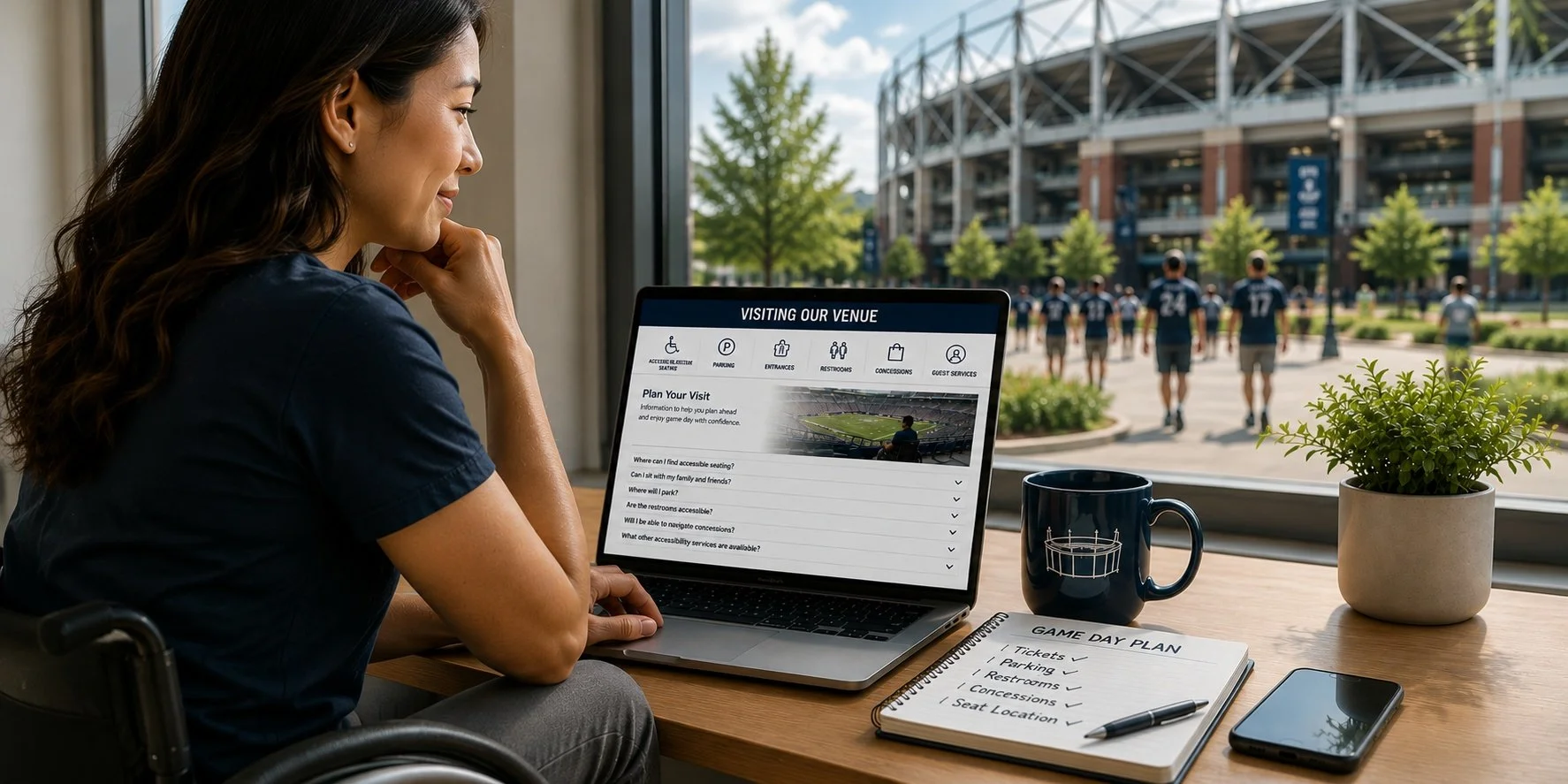
For many fans, buying a ticket is the beginning of an exciting game day. For many fans with disabilities, a list of accessibility questions is the start of their game-day experience.
Can I find accessible seating? Can I sit with family and friends? Where will I park? Are the restrooms accessible? Will I be able to navigate concessions? Where can I find information on accessibility before I arrive?
The answers to these questions, and the ability to find the answers, often determine whether going to a game feels exciting or uncertain. When these questions go unanswered, many fans don’t simply “figure it out.” They may postpone attending, choose another activity, or decide the uncertainty isn’t worth the risk.
As a lifelong sports fan and a person with a disability, I have experienced this firsthand every time I attend a game. Every venue is different, and every visit requires some level of research before ever leaving for the game. I have to plan my trip so I can spend my time enjoying the game, not worrying about what challenges I might encounter once I arrive.
Unfortunately, finding that information often requires searching multiple webpages, making phone calls, or arriving without knowing exactly what to expect.
Can I find accessible seating?
Buying a ticket should be a seamless first step, but for many fans with disabilities, it can be the first barrier.
Accessible seating isn’t always displayed clearly on a seating map, or the information provided doesn’t explain enough to know whether a particular seat will actually meet your individual needs. In some cases, accessible seating must be purchased with extra steps through a different process than other tickets.
I’ve arrived at my seat only to discover that what I thought was a wheelchair space is actually an immovable companion seat. I’ve been told to just buy a ticket and staff “will find a place for you” once you get there.
Having the information about seating options allows fans to purchase tickets with confidence instead of uncertainty.
Can I sit with family and friends?
One of the biggest reasons people attend sporting events is to enjoy them together.
For fans with disabilities, this can be a familiar challenge.
Nobody goes to a game hoping to watch it alone. The experience is cheering with friends, celebrating big plays together, and sharing memories. When accessible seating separates fans from the rest of their group, that experience changes. While companion seating is intended to keep you from being separated, many fans still wonder what seating options are available for larger groups before they decide to attend.
These are the kinds of questions that deserve clear answers prior to game day.
Where will I park?
Parking is often the very first interaction a fan has with your venue.
For someone who needs extra room to deploy a wheelchair ramp, has limited mobility, or cannot easily travel over certain terrain, accessible parking needs to be a prepared and calculated step in the game-day journey.
I’ve been directed from lot to lot trying to locate accessible parking before finally finding a space that left me much farther from the entrance than expected. Not having clear instructions and guidance to accessible parking locations created a challenging path of travel before entering the gates.
Are the restrooms accessible?
This is one of the most personal concerns many fans with disabilities have before attending an event.
Most people don’t think about restroom access until they need it. For someone with a disability, it’s often something that has to be considered before their trip begins. Where you choose to sit, where you enter, and your path of travel may all be chosen based on restroom location.
When you gotta go, you gotta go. If you don’t know where an accessible restroom is or whether it will meet your needs before you gotta go, then… well, I think you get it.
Will I be able to navigate concessions?
Getting a drink and some food is a simple task, right?
You get in line. Place your order. Pay. Head back to your seat.
However, this simple task can involve many not so obvious barriers: narrow queue lines can make it hard to navigate, high service counters can make it difficult to order, pay, and retrieve food. Navigating crowded concourses and long distances while carrying your drink and food can make it difficult to get back to your seat.
I’ve often been in this exact circumstance, holding on to my drink and food for dear life while navigating crowded uneven concourses trying to get back to my seat without incident.
Information on accessible paths of travel, assistance services offered, and what to expect can go a long way in preparing fans with physical disabilities.
From Questions to Confidence
None of these questions are asking for special treatment. They're simply asking for information.
So how can fans get the answers to their questions prior to attending the game? What can venues do better to help?
One of the most effective tools I’ve seen is a well-designed Accessibility Fan Guide.
A good fan guide presents the accessibility information fans are searching for. A single resource that answers the accessibility questions fans are already asking before they arrive.
Seating Information
Parking Locations
Accessible Entrances
Available Disability Aids
Accessible Restroom Information
Sensory Accommodations
Accessibility Services
Additional Contact Information
Rather than time spent researching through multiple webpages or making several phone calls, fans can find the answers to their questions all in one place.
An Accessibility Fan Guide is part of the fan experience. It’s a way of telling fans with disabilities, “We’ve thought about your experience before you even arrive.”
Bonus Content:
See an example of an Accessibility Fan Guide
See an example of an Accessibility Fan Guide Blog
Questions to Consider at Your Venue
Is your accessibility information easy to find, current, and comprehensive?
Would your website, ticket office, and game-day staff provide the same answers?
If you were temporarily disabled, would you feel confident arriving and navigating your venue?
Every fan deserves to arrive excited for the game, not uncertain about the experience. Accessibility information doesn’t just answer questions. It creates confidence before game day even begins.
Interested in evaluating accessibility through the eyes of your fans?
Access At Ease helps sports venues improve accessibility through accessibility assessments, Accessibility Fan Guides, and staff training that build confidence throughout the fan journey.
About the Author
Andy Garbarino is the founder of Access At Ease, an accessibility consulting firm that helps sports venues evaluate accessibility through the eyes of their fans. As a lifelong sports fan and a person with a disability, he combines lived experience with practical recommendations to help venues create more inclusive and confident game-day experiences.